
Trading Psychology

Reporting Season: More Opportunities Doesn’t Mean Trade More


If you traded reporting season, you’re probably exhausted by now.
It’s pretty much the most hectic trading period of the year for many traders. You sit down in the morning and half the market feels like it’s in play. Results are everywhere, plus there is the growing list of Day 2+ set ups to deal with. 

We’re seeing a whole new world in how far stocks can gap and then drive (or reverse) during the session … ranges that just didn’t exist two or three years ago. After the first week or so, it becomes almost impossible to keep tabs on everything. These wild moves can provide fantastic opportunities, but also considerable risk.
One thing worth keeping in mind is that having more opportunities doesn’t mean you should be trading more. If anything, it’s probably the time when I have to remind myself to be more selective, more focused and a little more patient.

For me, I’m finding much of that patience needs to be applied near open. Books are often thin and volatile and a lot can change as institutional orders and algos work their way into the market over the first 15–30 minutes. The market you see on the open can be completely different half an hour later.

We’ve seen plenty of that this reporting season. Sometimes it takes a good hour for a clear direction to emerge. Sometimes there simply isn’t one on day one.


This environment makes it very easy to feel like you have to be involved. I’m absolutely guilty of that and have been for most of my career. If you don’t take the trade, you might start thinking about what you’re missing out on. But you don’t have to trade every result. You don’t even have to trade every good setup.
Focus on the ones that make the most sense to you, offer the best potential risk/reward and, most importantly, suit the way you trade.


One of the things I’ve learned over the last 25 years is that sometimes the best thing you can do is wait — and waiting certainly doesn’t come naturally to me. The best trade might not even be on day one. It might be the follow-through trade tomorrow or several days later.


A trader I have huge respect for once said to me, “Taking no position is a position.”


Still one of my favourite trading quotes.


Cheers,


Alan
Traders Edge
Trade independently. Grow Together.
www.tradersedge.com.au

A useful tool to help eradicate your trading demons

You’ve followed all the apparent big hitters on Twitter.

You’ve watched countless hours of Youtube videos on trading.

You’ve bought, borrowed or stole every trading book you could get your hands on.

You’ve opened your first trading account and followed all the steps you’ve decided were the keys to success.

You’ve taken all the best signals.

…. and you’re still losing.

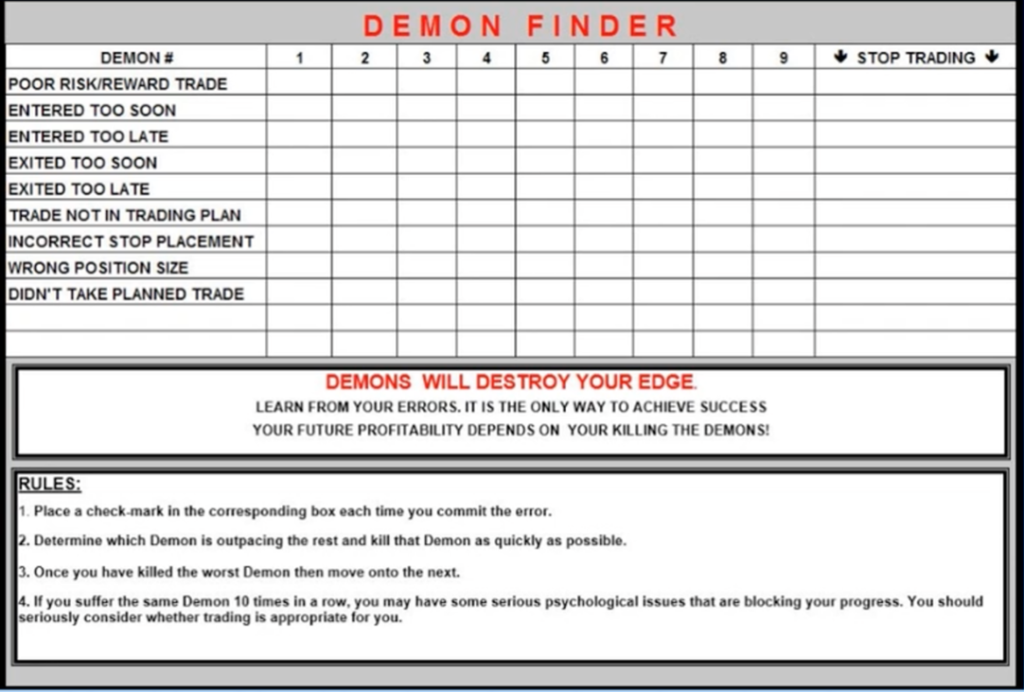
Finding your edge takes hard work, perseverance and often luck. But often what is holding you back is not the trades you’re taking, but an internal road block that is causing you to make recurring errors. You could dive deep into your own psychological DNA to find the root cause, but I think a better way to approach this “witch hunt” is to track them down in your actual trading results.

Tom Dante’s (@Trader_Dante) Demon Finder spreadsheet is a fantastic template to help you identify if you have an aspect of your trading that is consistently damaging your trading results. There have been several versions of this over the years but below is one of the originals:

Add or remove potential Demons according to your own personal experience and be vigilant and honest about checking a box EVERY time you make an error.

Once it becomes obvious where your most dangerous demon is lurking, then do everything you can to take this out of your game. Once you feel you’ve achieved this, then move onto the next. (Suggestions on how to correct these errors is one of the subjects often touched upon in our subscription community live chats)

This “slay your demons” concept is not unlike the inchworm process that Jared Tendler (@jaredtendler) covers in his excellent book, The Mental Game of Trading. Well worth a read in my opinion.

20 plus years on and I still use a version of this process, but mine is pretty simple now. Tacked to one one of my monitors is a piece of paper that simply reads “Don’t be shit Alan!”.

Once you’ve learnt how to trade, for me, everything else ever written can be summarised in those 4 words.

Want to work on the psychological side of your trading? Here’s the place!

As many of you may know, improving the psychological and emotional side of my trading has always been a key focus.

One site that I find incredibly helpful in this regard is Brett Steenbarger’s TraderFeed. There are a wealth of articles on market psychology and enhancing trading performance. Some of it is pretty heavy going, but it’s an absolute must read site for me…especially if I find my trading edge or discipline slipping.

Another large stash of articles written by Brett can be found at www.brettsteenbarger.com

Happy reading!

Alan

Scroll to top